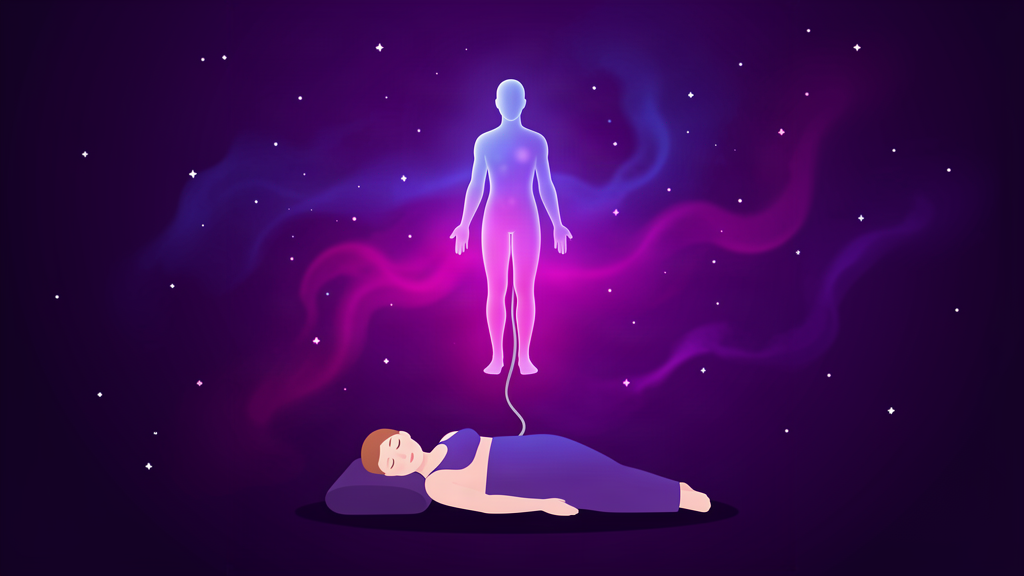
Astral Projection LG · A Practical Guide A glowing translucent figure floating above its sleeping body on a dark purple cosmic background, connected by a luminous silver cord.
Learn to leave your body, on purpose.

A research-backed, step-by-step guide to astral projection — what it actually is, what modern neuroscience makes of it, and exactly how practitioners across a thousand years have learned to do it. Take your time. The body waits.

Section 01

What is astral projection?

Astral projection (also called astral travel, soul journey, or out-of-body experience / OBE) is the practice of deliberately inducing a state in which your conscious awareness feels as though it has separated from your physical body and is traveling outside it. Practitioners across cultures describe the same core experience: a sense of floating, leaving the body behind, and moving through places — sometimes the real-world room around you, sometimes vast symbolic landscapes collectively called the astral plane.

~10%
of people report a spontaneous OBE in their lifetime
5,000+
years of recorded practice, across every continent
1
brain region (the TPJ) primarily implicated
4–8 Hz
theta brainwave band where most exits occur
The single most important sentence on this page: the experience of leaving your body is real, well-documented, and reproducible. The metaphysical claim that a literal soul is physically separating is a different question — and the honest answer is that science cannot confirm it. This guide teaches the first, treats the second with respect, and never lets either get in the way of the practice.
Section 02

What does the brain actually do?

Neuroscientists and psychologists classify OBEs as dissociative experiences — the same family as lucid dreams and depersonalization. They are caused by a temporary disruption of the brain region that normally stitches together three things:

1 · Body ownership

Where your body is, that it's your body, and how it feels from the inside (proprioception).

2 · Visual perspective

Where your eyes are and what they're looking at.

3 · Sense of "self in space"

Where you are, right now, in the world.

The temporal-parietal junction (TPJ)

When the brain area that integrates those three signals glitches, the brain loses its anchor. You can see your body from a viewpoint that isn't your eyes, and that mismatch is the out-of-body experience. In 2007, Swiss researchers published the first case of a full OBE triggered on demand by electrical stimulation of the TPJ in an epileptic patient — when the stimulation stopped, the experience ended (Blanke et al., Brain).

What confirms it

OBEs can be reliably triggered by dissociatives & psychedelics (ketamine, PCP, DMT, psilocybin, LSD, MDMA) — drugs that act on the same temporal-parietal and precuneus regions. Cross-confirmation: change the chemistry, change the integration, get the experience.

What doesn't change

Controlled parapsychology experiments (trying to remote-view hidden targets during OBE) have not produced statistically above-chance results once selection effects are accounted for. The experience is real; the perceptual claims remain unproven.

Practical takeaway: you don't need to believe anything metaphysical to learn astral projection. All you need is the ability to hold your body in a relaxed state, keep your mind awake at the edge of sleep, and recognize the characteristic signs of dissociation when they appear.
Section 03

Where the idea came from

The conviction that consciousness can travel outside the body is genuinely ancient, and shows up independently in every major civilization we've found records from. The English phrase "astral projection" was coined in the 19th century by the Theosophical Society; the practice itself is much older.

Ancient Egypt

The ba (soul) was said to hover over the mummified body via the ka (subtle body), as depicted in the Book of the Dead.

Inuit & Amazonian shamanism

The angakkuq of Inuit culture and the yaskomo of the Waiwai both deliberately soul-travel for healing, divination, and naming children.

Hindu / Vedic

Described as the Liṅga Śarīra (subtle body) in the Yogavashishta and the Mahabharata. One of the siddhis attainable through disciplined yoga.

Japan & China

The ikiryō of Japanese folklore — a person's spirit leaving their sleeping body — and the separation-of-spirit-body meditations in The Secret of the Golden Flower.

19th-century Theosophy

Blavatsky and the Theosophical Society coined the English term astral projection and formalised the "astral plane" as the first layer beyond the physical.

Robert Monroe (1971)

American radio executive whose book Journeys Out of the Body sold a million copies and replaced the spiritual label with the neutral scientific-sounding phrase "out-of-body experience." He founded the Monroe Institute, which still teaches OBE induction today.

Fun footnote: the US Army's Intelligence and Security Command (INSCOM) sent personnel to Monroe's Institute in the early 1980s. A declassified 1983 report titled "Analysis and Assessment of Gateway Process" evaluated the technique as part of the same remote-viewing program that later became the famous "Stargate" files.
Section 03.5

What it's actually like

Before we get to the actual practice, it helps to know what the experience tends to feel like — the specific sensations you'll be looking for, in roughly the order they appear, so you recognize what's happening and don't panic out of it.

Common · The floating sensation

The body feels weightless, lighter than the bed. Many practitioners report a sudden sense of being lifted or tipped — gently, not violently. Sometimes accompanied by a faint humming or pressure. This is the threshold. If you stay calm and don't try to "analyze" it, the next stage usually follows within seconds.

Common · Seeing the room from above

Many first-time exits don't involve leaving the room — they involve looking down at the body from a few feet above, sometimes the foot of the bed, sometimes the ceiling. The room looks correct. Details — books on a shelf, your phone's screen — are often reported as accurate, though accounts vary.

Occasional · Meeting beings

Reported entities vary wildly: spiritual guides, deceased relatives, unknown figures, "presences" that have no form. Most of these encounters are emotionally neutral or peaceful. Some practitioners report hostile or frightening entities — almost always during entry, never after stabilization.

Rare · Visiting other realms

The "astral plane" of the older literature — vast cities, libraries, schools, healing temples, sometimes described as higher-vibration landscapes. Reports are rarer than the floating/waking-up variety, but striking enough that practitioners often keep notes for years. Whether these are objective places, shared archetypal imagery, or purely subjective is unresolved.

Common · The silver cord

Many practitioners describe a luminous thread, usually silver or gold, running from the chest or navel back to the physical body. It's reported as automatic — not something you create — and is associated with the feeling of always being able to return.

Common · A sense of "coming home"

Surprisingly consistent across cultures and practitioners: the first few minutes of a clear OBE are often marked by an intense sense of recognition, relief, or familiarity — as though the state is more normal than everyday waking life. Many people find this disorienting for days afterward.

A quick reference: sensation → frequency

The table below is a composite of practitioner surveys (Monroe Institute, Astral Codex, r/AstralProjection). Frequency ratings are subjective across thousands of self-reports.

Sensation Description Frequency
Floating / lightness Body feels weightless; sense of being lifted or rising from the mattress. Common
Vibrations & humming High-pitched tone, whole-body buzzing, or a rushing white-noise roar right before the exit. Common
View from above Seeing your sleeping body from a few feet above, often the foot of the bed. Common
Silver cord A luminous thread perceived connecting the astral body to the physical body. Common
Meeting a guide or being An entity — spiritual, deceased relative, or unnamed presence — encountered during exit or travel. Occasional
Recognition / familiarity A sudden feeling of the state being more "normal" than ordinary waking life. Occasional
Visiting other realms Large symbolic landscapes (cities, libraries, schools, temples) distinct from the physical room. Rare
Distant remote viewing Accurate perception of far-away people or places that the practitioner is not currently near. Rare
Astral travel allows us to explore the universe beyond the limits of our physical form. — A common description from practitioner surveys
Section 04 · The Core Guide

How to astral project — a real, step-by-step practice

This is the consolidated method taught by Robert Monroe, refined by practitioners like William Buhlman, Robert Bruce, and hundreds of modern guides who have worked it night after night. It is the simplest reliable entry point and the one I'd start with tonight.

Listen Along

Guided session · ~13 min loading…
0:00 / 0:00
Best setup: use stereo headphones — binaural beats only work with each ear hearing a different signal. Lights off. Phone face-down. Lights-off and quiet for the full 13 minutes. Hit play, then close your eyes and follow Jessa's voice. The binaural floor does the rest.
  1. Pick your time

    The window of choice is the early morning — roughly an hour before you'd normally wake up, or in the first few minutes back to sleep after a night waking. Your body is rested, your mind is just surfacing from sleep, and the dissociation threshold is at its lowest. Set an alarm if you have to, but the opposite — staying up deliberately — works too once you know the technique.

  2. Prepare the room

    Dark, quiet, warm. No electronics glowing where you can see them; silence your phone (or face-down, dark). A partner in the bed is fine if they sleep still, but solo is easier for the first few months. Never drive, walk near cliffs, or do anything physical during this practice — you're lying down.

  3. Lie on your back, arms at your sides with palms up

    This is the position you saw in the video, and it's the right one. Palms-up is important — it's an open, receptive posture, and the slight change in shoulder position helps the body relax more deeply than arms crossed on the chest. Head on a thin pillow (or none). Allow your feet to fall slightly apart; let your jaw drop a fraction of an inch.

  4. Set a single, simple intention

    Close your eyes. Silently say something like: "I will consciously leave my body." Say it once, with quiet conviction, and then let it go. Do not repeat it — the moment of declaration is the seed. From this point on, your only job is to relax, not to "do" anything else.

Induction — the actual practice

  1. Progressive muscle relaxation, head to toe

    Starting at the crown of your head and moving slowly down to your toes, mentally soften every body part in turn. Many practitioners find it helpful to tense a body part for 3–5 seconds, then release — the contrast makes the relaxation feel deeper. Move: scalp, face, jaw, throat, shoulders, arms, hands, chest, belly, hips, thighs, calves, feet. Spend longer on the jaw and the shoulders — that's where most people hold unconscious tension. Do not skip this. The body has to be asleep first; only then can the mind stay awake.

  2. Slow your breath, breathe from the belly

    Long, slow exhales. Inhale through the nose for about 4 counts, exhale through the mouth (or nose) for 6–8. Within a minute or two the body will start to feel heavy and warm — that's the parasympathetic shift. Don't change the rhythm once it feels right; just keep going.

  3. Enter the hypnagogic state — body asleep, mind awake

    This is the state Monroe called Focus 10, and it is the actual gateway. You'll know you're there when:

    • Your body feels heavy, distant, or completely absent.
    • You can't tell whether you've breathed in the last thirty seconds.
    • Random images, faces, colors start appearing behind your closed eyes — these are hypnagogic hallucinations, a normal sign you're close.
    • You might experience a sudden full-body twitch (a hypnic jerk) — that doesn't mean you failed, it means your body is settling into sleep.

    The first time you hit this it can feel strange. Just stay. Don't try to "do" anything yet.

  4. Wait for the vibrational state

    Many practitioners — not everyone — report a characteristic band of sensations just before the exit:

    • A high-pitched tone or rushing white-noise roar in the ears.
    • A buzzing or vibrating sensation that runs through or just outside the body.
    • A feeling of pressure, usually at the forehead or the chest.
    • Mental images that start to take on life — they move, have detail, persist.

    This is widely reported, has been written about for at least a century, and is the strongest single signal that an exit is imminent. Do not try to make it stop. Just stay calm and wait.

  5. Exit — pick one method and commit

    The vibrational state is your runway. You do not need to wait for it to "finish" — most practitioners exit during it, not after. Choose one of these exits and do not second-guess:

    Method A · Lift-out

    Imagine (do not "try hard"; just gently visualize) that your awareness slowly rises straight up out of your chest, like a helium balloon. Don't yank — just imagine the upward motion and let it continue. Most exits with this method are floaty and slow.

    Method B · Roll-out

    Imagine (or mentally intend) that your body rolls to one side, off the bed, just as you might roll over in sleep. The first few seconds will feel as though the physical body really is rolling — then you'll find yourself in a non-physical duplicate of the room. Many beginners get their first OBE with this method.

    Method C · Rope technique (Robert Bruce)

    Visualize a glowing rope hanging above your chest. Reach up with one astral hand and pull it down a hand's width. Reach with the other. Repeat, until your astral body is sitting upright above the physical. Best for people who wake up inside sleep paralysis and need a clear kinetic task.

    Method D · Stand-up

    Most direct, also most jarring. Once you're in the vibrational state, simply intend: "I'm now standing up." Don't visualize it; just assume the position. Some practitioners stand up on the first try; others need this method several nights in a row before it works.

  6. Stabilize

    The first 5–10 seconds after exit are the most fragile — you'll lose lucidity if you panic, get excited, or start moving too fast. Three stabilizers, in order of how often they're taught:

    • Move a hand. Wiggle fingers or a foot of the astral body. Touch a wall, the bed frame, anything solid.
    • Speak out loud: "Clarity now!" or "Increase focus!" — voice activates the non-physical body.
    • Look around slowly. Describe the room out loud — every detail you can — for at least 15 seconds.
  7. Explore (optional) and return

    When you feel stable, you have a real choice: stay in the immediate room (a local exploration, useful for practice and for confirming the experience is reproducible), or travel farther. Always set an intention to return before doing anything else — to yourself, to your physical body, in a known number of minutes. Most beginners return naturally within 10–20 minutes; some get pulled back instantly by a sudden noise.

  8. Return to your body

    The return is usually automatic. You'll feel a gentle tug — the "silver cord" idea, or simply the body reabsorbing attention. You can also deliberately reverse your exit: if you lifted out, simply float back down; if you rolled out, reverse the roll; either way, intend "I am now back in my body" and feel the shift.

What to do the first few times you don't succeed: nothing different. Most practitioners take weeks to months of nightly attempts before the first conscious exit. The state you're after is a very specific neurochemical window — any alcohol, any caffeine within ~6 hours, any recreational drug, any food in the last hour before practice, or any attempt to "force" it will close that window. The work is showing up rested and doing the same 20-minute routine every night until it happens.

A complete checklist, in order

  1. Before: no food for 1 hr · no caffeine for 6 hr · no alcohol for 12 hr · lights off, phone away.
  2. Position: flat on back, palms up, feet slightly apart, jaw relaxed.
  3. Intention: silently state "I will consciously leave my body" — once, then let it go.
  4. Relax: progressive scan from head to toes; long slow exhales.
  5. Hypnagogic: hold the line where the body is asleep and the mind is awake (Focus 10).
  6. Vibrations: when they appear, don't fight them.
  7. Exit: pick one method and commit; don't second-guess.
  8. Stabilize: touch, speak, look — the first 10 seconds matter most.
  9. Explore & return: set a return window in advance; reverse your exit when it's time.
  10. After: write down what happened the moment you're fully awake — even "nothing happened" — and keep a journal.
Section 05

Other reliable entry methods

The Monroe-derived practice above is the best general-purpose method, but it isn't the only one. Pick the one that fits how you fall asleep, and switch if the current method stalls for more than a few weeks.

Sleep paralysis entry

Sleep on your back for a few nights. When you wake up unable to move, don't panic. Say silently: "I am in sleep paralysis; my consciousness is awake; I will now separate." Most people who frequently get sleep paralysis have their first OBE within a week of adopting this protocol.

Works for: chronic SP sufferers

Lucid-dream bridge

Become reliably lucid in a dream (reality checks, dream journal, MILD/WILD techniques). Once inside the dream, walk toward a doorway, mirror, or wall and intend to pass through it. Many practitioners report the dream collapses and you "snap" into an OBE on the other side. Easier than direct induction for people who already lucid-dream.

Works for: lucid dreamers

Yoga Nidra / NSDR entry

Yoga Nidra ("non-sleep deep rest") is a guided practice specifically designed to put the body into deep relaxation while keeping the mind consciously engaged — exactly Monroe's Focus 10. Anywhere from a 20-minute YouTube session to a full 45-minute body scan often ends in either an OBE or a deep conscious nap that's equally restorative.

Works for: beginners, anxious minds

Hemi-Sync & binaural beats

Monroe's patented audio technique — a different frequency in each ear, the brain perceives the difference (typically a 4 Hz theta beat) and tends to synchronize with it. Free binaural-beat tracks on YouTube work for many people; the official Monroe Institute Gateway program is the gold standard. Headphones required.

Works for: people who can't "just relax"

WBTB — Wake Back to Bed

The single most reliable timing trick in the entire practice. Set an alarm for 90 minutes before you'd normally wake up. When it goes off, get out of bed for 15 minutes (no screens, just move around, drink water, stay awake), then lie back down with the intent to return to sleep while staying conscious. Your first sleep cycle was deep; the second one is shallow — exactly the threshold you want for an exit. Practitioners who fail every other method usually succeed with this one.

Works for: schedule control

Sensory-deprivation float

Float tanks (10 inches of warm water saturated with Epsom salt, total silence and darkness, ~60 minutes) can produce the same dissociation on demand. Among the most reliable single-session inductions ever tested, but it requires equipment and money.

Works for: one-off guarantee
Section 06

Skeptics & misconceptions — answered honestly

Most people who give up the practice don't give up because it doesn't work — they give up because someone they respect tells them it can't. Here are the specific objections you're likely to hear, and the honest answer to each.

The four most common objections

"It's dangerous. You could get lost, or not come back."

There is no documented case of a person being physically harmed by astral projection, or failing to return. The body continues to breathe, regulate temperature, and respond to stimuli regardless of where the practitioner's attention is. Some people experience brief sleep paralysis or a sense of "floating" after returning — neither is dangerous. The only real risks (sleep fragmentation, anxiety in predisposed people) are covered in the Safety section above.

"Only spiritually gifted people can do it."

Anyone with a working vestibular system and the ability to fall asleep can learn to do it. Spontaneous OBEs happen to roughly 1 in 10 people. With consistent practice, the majority of motivated beginners have their first conscious exit within 4–8 weeks. "Gifts" don't enter into it; relaxation and intention do.

"It's just lucid dreaming dressed up."

There is genuine overlap — both involve heightened awareness within an internally-generated experience. The distinguishing feature experienced practitioners report: in an OBE, the world around you looks like the physical room you actually left, often including accurate details you haven't seen (a book spine you couldn't normally read from the bed). Lucid dreams feel like dreams; OBEs tend to feel like being awake somewhere else. The two are related, but not identical.

"There's no scientific evidence, so it's just delusion."

The neuroscience of the underlying brain state (TPJ dissociation, drugs producing the experience) is well- documented. The metaphysical claim — that a non-physical soul literally travels — has not been proven, and several controlled parapsychology experiments failed to detect above-chance accuracy in remote viewing. That doesn't mean the experience isn't real; it means the experience is reproducible without the soul leaving. Treating it as pure delusion also doesn't fit the evidence.

The honest summary: the practice is real, the experience is reproducible, the metaphysical interpretation is unverified. Most practitioners eventually settle on something like: "I don't know what's happening, but it's consistent, predictable, and useful — so I keep doing it." That posture is more durable than either belief or denial.
Skepticism is the first step towards truth. — Denis Diderot
Section 07

Risks, side effects, and how to stay safe

Astral projection is genuinely low-risk compared to most practices people spend years on — but it's not zero. Knowing what can go wrong is part of doing it well.

Common · Sleep paralysis

Most practitioners hit it within their first month. Awareness without movement, sometimes with intense visual and auditory hallucinations. Normal, harmless, ends within seconds. The protocol is described in the Techniques section above.

Common · Vivid false memories

OBEs blend with dream memory easily. Keep a paper journal beside the bed and write everything down the moment you're awake — within 10 minutes, the dream/O distinction blurs fast.

Common · Lingering dissociation

A few people report a "not-quite-here" feeling for hours after practice. Grounding fixes it: cold water on the face, holding ice cubes in both hands, eating something, going outside barefoot for 60 seconds.

Less common · Sleep disruption

The technique requires long periods at the sleep edge; if practiced at the wrong hour it can fragment sleep. Choose one window (early morning is easiest) and stick to it.

Rare · Tachycardia / panic

Anxiety during entry can briefly elevate heart rate. People with cardiac conditions should check with a doctor first, especially if combining with sleep deprivation.

Special case · Pre-existing conditions

If you have a dissociative disorder (DPDR, DID), a psychosis-spectrum diagnosis, or untreated PTSD, talk to your clinician before regular practice. Deliberate dissociation is therapeutic for some people, destabilizing for others.

The "silver cord." If you've heard that a silvery thread connects your astral body to your physical one, never breaks, and guarantees safe return — that's a tradition more than a finding. Treat it as a helpful visualization for setting intentions, not a physical tether. The reason OBEs always return you to your body is mundane: your attention has to go somewhere, and the bed is still right where you left it.
Never practice while driving, walking near heights, doing anything physical, or in any position other than lying or sitting safely. The whole point of the technique is dissociation — you do not want to be dissociated from your legs while they are still expected to be useful.
Section 08

Frequently asked questions

Does this really work, or is it just lucid dreaming in disguise?

The boundary is debated even by practitioners. The clearest distinction made by experienced projectors: in an OBE, you perceive the world from your physical body's actual location (you can describe your room accurately without looking) and the experience has an unusually lucid, non-narrative quality — it doesn't progress like a dream. Most first attempts are partly one and partly the other. Whether they're "the same" or "different" matters less than whether they produce useful experiences.

How long until I get a real OBE?

Highly variable. Some get one on the first or second attempt; most take 4–8 weeks of nightly 20-minute sessions; a few take much longer. What reliably speeds it up: keep a journal (so you notice progress), stay consistent (don't skip nights "because you feel it coming"), and avoid the substances listed in the checklist.

Will I get stuck "out there"?

No. Real-world cases of people failing to return to their bodies do not exist. Even very long OBEs (Monroe reported some lasting hours of subjective time) always end with the practitioner back in bed; the body is undamaged. The "silver cord" is a metaphor for a real fact: the body is doing all the work and will wake you up as soon as it has to.

Should I tell anyone I'm practicing?

Up to you, but most people who do keep it private the first few months. The cultural reaction is often dismissive, and arguing about whether it's "real" is a distraction from actually doing it. Find one or two like-minded people (a subreddit, a Discord server, a local meetup) and share experiences there.

Can children astral project?

Spontaneous OBEs in children are reported in the literature, but deliberately taught practice is generally not recommended before adolescence — partly because the relaxation / dissociation practice overlaps with techniques a child should be talking to adults about (meditation, hypnosis), and partly because it interferes with normal sleep architecture at a critical age.

What's the difference between this and a near-death experience?

Some researchers classify NDEs as a category of spontaneous OBE — they share the same brain mechanism (TPJ disruption). The big differences are the typical content (NDEs often include tunnel, beings of light, life review, reluctance to return) and the cause (cardiac arrest, trauma, drowning). This guide is about the standing-in-bed kind, not the kind brought on by an emergency.

A final note

Show up tomorrow night.

Astral projection is one of the few genuinely life-changing skills that costs nothing, requires no equipment, and improves with patience rather than degrading. The "trick" is the same as the "trick" for any deep practice: consistent small sessions, a written log, and the willingness to do it again even when nothing happened last time.

The body knows what to do. Your only job is to keep showing up long enough for it to do it.

Back to the guide